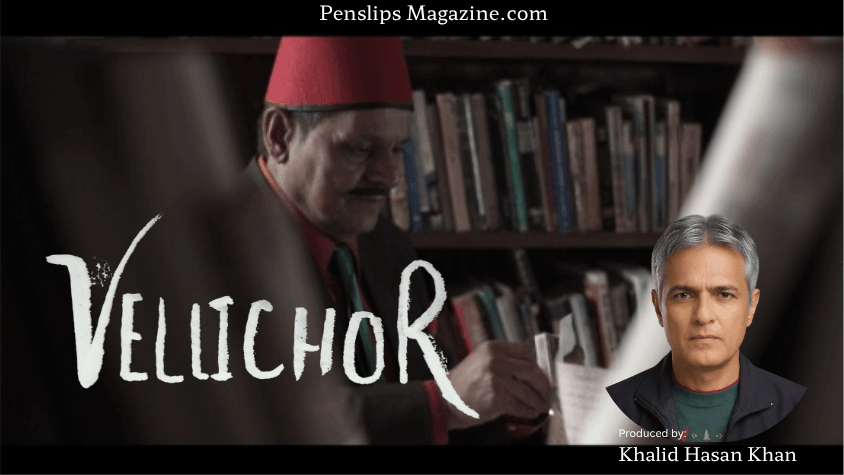
VELLICHOR: Khalid Hasan Khan on Making Pakistan’s First Literary Thriller
The word vellichor describes a feeling many of our readers might be familiar with. It’s the wistful nostalgia one experiences while wandering through old libraries and old book shops, the scent of yellowing pages, and the intimate melancholy of stories that have survived generations. It is precisely this sensation that the Pakistani filmmaker Khalid Hasan Khan has turned into a thriller.
VELLICHOR is a 40-minute literary thriller filmed inside Karachi’s iconic Frere Hall Library, a majestic colonial-era building that houses nearly 70,000 books. The film follows Hadi, a librarian determined to save the library from being seized and converted into a software house. Standing with him is Warqa, the spirit of the paper itself. VELLICHOR is, by Khalid’s own description, Pakistan’s first literary thriller.
Khalid Hasan Khan has spent his career making films that resist easy categorisation, but always circling the same concern: what we stand to lose when progress outpaces preservation. VELLICHOR is his latest project, and ahead of its release, Penslips spoke with him about what it means to make a film in defence of the written word.
Q. The story revolves around a son attempting to convert his father’s library into a software house. How close does that feel to something you’ve actually witnessed or feared in Pakistan?
Yes, in fact, we see all around us how farms are being turned into real estate businesses, bookshops into restaurants, and our heritage is in ruins, our legacy has been compromised. Newspapers have been reduced to TV channels, and media houses have become YouTube accounts. This reduction is the writing on the wall.
Should we attribute it merely to the changing digital landscape, or is it primarily greed and ignorance? Western societies do not tamper with their lasting legacies; and if they do, it is only after reaching a certain level of advancement. We, however, are progressing in a copycat manner, resulting in stunted growth. Software houses are not inherently bad or good, but the hardware of the mind must be developed and fixed first, in a developing country.
It is being witnessed every day, yet our eyes are tight shut. In the coming days, we may well find ourselves saying that we are now reading books, newspapers, and magazines on reels. The point is simple: a book is curated, a newspaper is edited, a magazine is refined, but anyone who lacks the discipline or luxury of deep reading can easily become a mouthpiece of disinformation and a representative of illiteracy, by acting as an influencer on the digital media. Trends and viral content don’t make a nation great!
Q. VELLICHOR carries many concerns at once — women’s education, declining reading culture, the future of libraries, digital versus print. What is the single thread that holds all of it together for you?
The fictitious character of Noor-un-Nissa is the prime concern. Deep down, I tried to relate the library as the lap of a mother, who is the first nursery of a child. Women’s education is highly significant; if the mother is not literate, neither will the child be. So the library becomes a symbol of the mother’s sanctuary for the children, whereas the collection of stories that a mother tells her child is like a library of books; no stories, no upbringing.
Declining reading culture is another concern for VELLICHOR: storytelling itself is fading, and for the new generation the only sources of learning are either compulsory textbooks or indulgent social media. Libraries are also poorly funded, which VELLICHOR addresses as an institution that should never be breached like a bastion of learning. Hadi, the protagonist of VELLICHOR, stands up to save the library as a public trust.
So the library is another prime concern, which these days is essentially becoming a museum, very few readers go there. And the point you raised about digital versus print is equally important. Have you not often seen Socrates, Ghalib, and Krishan Chander misquoted on social media? If they are removed from print and context, they become a football in the social media soccer club.
So, to make it simple and short, VELLICHOR wants to save the children through the lap of the mother, and the library is its symbolic gesture.
Q. You filmed inside Frere Hall with 70,000 real books around you. Was there a specific moment during the shoot where the space itself did something unexpected?
70,000 books were our real stars, and all our characters were non-actors; they had never been on camera before. Unexpectedly, the space invoked a reverence for books, and they acted out their lines according to the character requirements. All were wearing makeup and costumes, but as it is rarely expected to perform such literary dialogues, all pulled off a brilliant act.
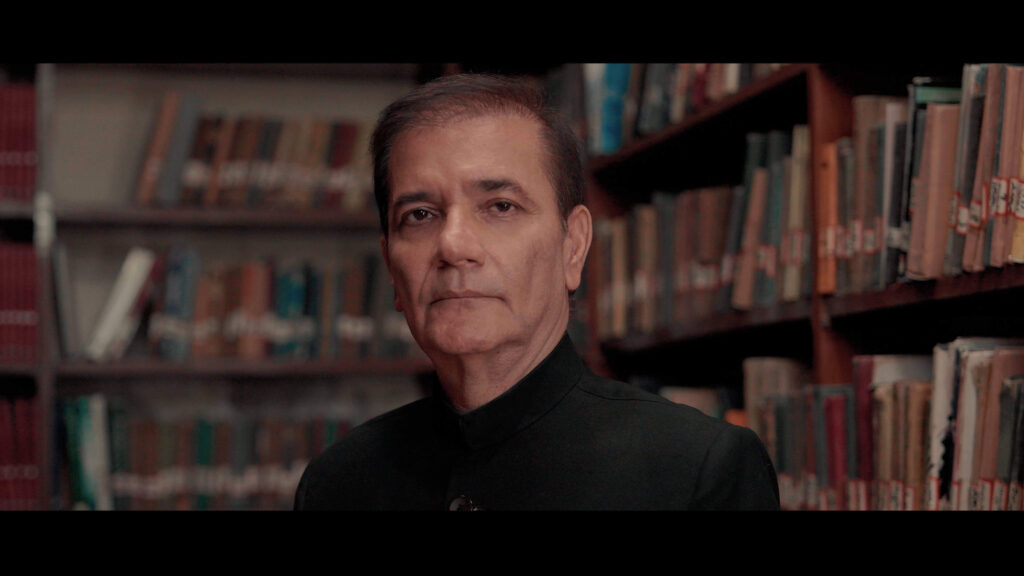
The protagonist, Dr Syed Saif ur Rehman, had never been part of any fiction or non-fiction project earlier. He carried the mental and emotional burden of the film, delivering the content in a black sherwani in sweltering temperatures. Even with the air conditioning on, no one expected a Sahara-like real feel inside the Frere Hall Library.
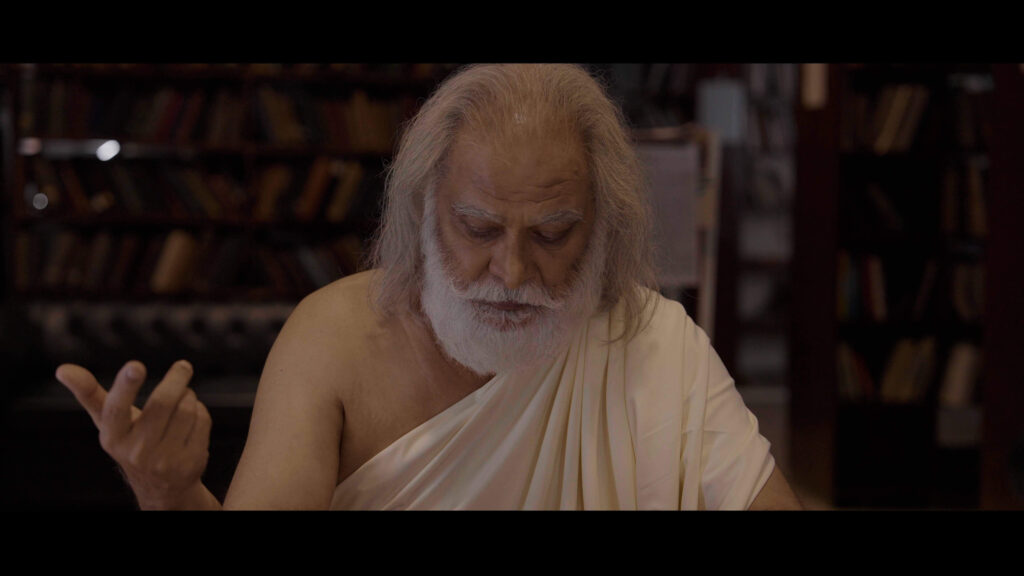
Likewise, Shamim Sherazi wore blue lenses, for the first time in life, and a Roman toga; he was depicting the character of Warqa. With well-aired garments, he felt comfortable and delivered a classic performance of “the spirit of the paper.” The same goes for the rest of the cast, Aayan Hussain, Talal Farhat and MeMe Hussain.
The unexpected surprise for the filmmaker was to complete the project within the given temperature, circumstances, means, and budget. Because, at the end of the day, 70,000 books are the simon-pure stars, and they behave as per your expectation. Decent and dignified!
Q. You’ve spoken about wanting this to be a movement, not just entertainment. What does that actually look like the morning after someone watches VELLICHOR. What do you want them to do differently?
Proof of the pudding is in its eating. My earlier project was Screen Locked, with Alyy Khan and Mohsin Atabik, about digital addiction. We showcased it at SOT (School of Tomorrow), the Lahore Literary Festival, The Blackhole, Islamabad, and the Karachi Literature Festival. The 30-minute film also gained international recognition by winning The Best Shorts Competition, United States, earlier this year.
It was not just a film but thought leadership content. When you make a film dissuading the audience from being screen-locked, you must also offer a remedy. VELLICHOR is that panacea, sparks an urge to read and care about books. So VELLICHOR is part of a broader movement to galvanize viewers to think twice before tapping and swiping their gadgets.
We had audiences ranging from 500 to a minimum of 100 across screenings of Screen Locked, from all ages and backgrounds, and no one left during the screenings. On top of that, we held intense Q&A sessions afterward. Entertainment happened on screen, and debate followed after it.
A good film, at the end, should get people talking. The morning after watching VELLICHOR, the idea is to return to books, digests, magazines, and newspapers. But, don’t forget, a film is not a medium of sermon, but it is the most effective way to kindle someone’s life in a unique way.
Q. You’ve described VELLICHOR as Pakistan’s first literary thriller. What made this kind of film difficult to make here? What were the challenges? Creative, financial, or something else entirely?
This kind of film is not made, or cannot be made in many regions. Everyone suspects the outcome, because such works often become didactically boring on the page. The first step in any such project is to rivet the interest of stakeholders by capturing their attention on the page itself. If the script feels like dry advice to read books, then no one would produce or act in it. VELLICHOR, as the first literary thriller, is as thrilling as it is literary. It follows a classic three-act structure, with a twisted plot and an unexpected ending. VELLICHOR is an original screenplay, a story no one has ever heard before.
As a filmmaker, the challenges of such a project are significant. Many filmmakers approach mainstream actors who are unfortunately not always suited for such an adventure; they cannot always engage with the lines, as they treat the material as overly bookish. Our lead, Hadi, is a doctor of medicine and also holds a PhD, so he knows how to handle the props on set. Books do not give him allergies, and newspapers and magazines are not coffee-table material for him.
Our talent industry is not fully ready for such challenges, and it is indeed very difficult. Safety zones are not finishing lines in the filmmaking business. But thankfully, our co-producer Syed Ovais Ali took up the project. We are glad that existing print media and digitally rooted publishing houses still believe that every story begins with a word, even visual content on social media is incomplete without a written word. VELLICHOR sees the light of day with the kindness of such collaborators who believe that books are still the best vellichorous friends of humanity.
When I first watched the trailer, I found myself appreciating what I saw, but I was also wondering if VELLICHOR would be another well-intentioned sermon disguised as cinema. Will it have scenes that will preach the value of books to people? In the interview, Khalid himself acknowledged this risk. That he was aware of it while making this film is reassuring. Whether he has succeeded in navigating it remains to be seen.
What stayed with me longer, though, was WARQA, the spirit of paper, the embodiment of intellectual heritage, appearing in a Roman toga. It’s a deliberate choice, carrying the weight of classical antiquity and intellect. It works as a visual.
But it also opens a question worth sitting with: what would the spirit of paper look like if it were dressed in something closer to our soil?
The Indus Valley civilisation, one of the most sophisticated ancient civilisations, left behind a script that nobody has yet deciphered. No translated texts, no recoverable stories, or philosophical tradition we can point to and say, this is where our intellectual heritage begins.
That script is still waiting, and perhaps that is itself a story worth telling.
VELLICHOR, without meaning to, holds a mirror to that waiting.
Khalid Hasan Khan
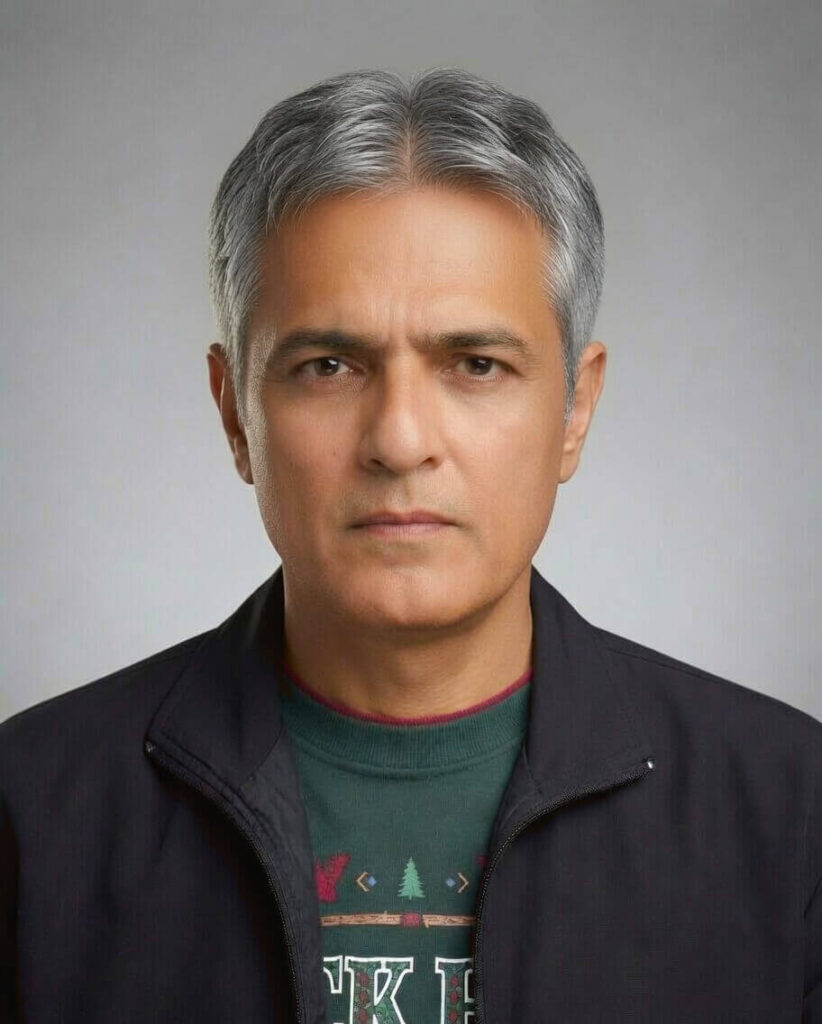
Khalid Hasan Khan is a filmmaker and writer whose films have screened at over 100 international festivals across Asia, Europe, and North America, earning 27 awards. A Producing graduate of the New York Film Academy, Los Angeles, he first introduced himself to international audiences with Hotal, a psychological feature, followed by Barefoot, a documentary on Pakistan’s interfaith football culture, and Screen Locked, a techno-thriller about digital addiction that won the Award of Merit at the Best Shorts Competition in the United States. VELLICHOR is his latest film.